
Norway to Host the International Polar Year 2032–2033
Norway is taking on a leading role in global polar research as UiT The Arctic University of Norway, together with the Norwegian Polar Institute and partners from South Korea and Chile, will host the secretariat for the Fifth International Polar Year (IPY-5).
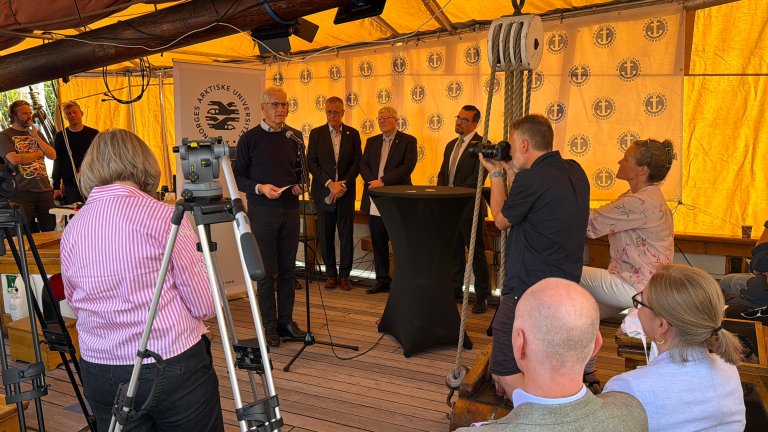
The news was announced by Prime Minister Jonas Gahr Støre during Arendalsuka on Wednesday, August 12. Tromsø will serve as the main hub for coordinating global polar research over a ten-year period leading up to, during, and following the official Polar Year in 2032–2033.
The International Polar Year aims to address urgent global challenges by advancing polar research, with a particular focus on the impacts of climate change in the Arctic and Antarctic. This coordinated effort will bring together researchers, Indigenous knowledge holders, and global stakeholders to generate actionable insights for climate mitigation and adaptation, while fostering international collaboration and inclusivity.
"The fact that the University of Tromsø is taking on this role now means that we in Norway are given a main responsibility for coordination, direction, and prioritization," said Prime Minister Jonas Gahr Støre at the press conference.
"It is a real feather in the cap for the entire polar research community in Tromsø, the Arctic capital, that this responsibility now lies there. For me, it has always been important that Norway, as a small country, maintains an intellectual lead on these issues. People come to Norway because we have worked on something over time that is valuable to understand, and because we have environments capable of collaborating well across disciplines. It matters for Norway, for our security, and for our geopolitical position that the major powers come to us and that we secured the secretariat for international cooperation in Tromsø," said Gahr Støre.
Accelerating Research in Response to Rapid Change
Historically held every 50 years since 1882—with the most recent occurring in 2007–2008—the International Polar Year is being moved up ahead of schedule. The reason: climate change in the polar regions is progressing so rapidly that the need for updated knowledge, observational data, and international coordination has become far more urgent than ever before.
Bringing the Arctic and Antarctic Together
The secretariat will be led by UiT in collaboration with:
- Norwegian Polar Institute (NP)
- Korea Polar Research Institute (KOPRI)
- Instituto Antártico Chileno (INACH)
Work begins this coming winter, backed by a total budget exceeding NOK 100 million. The initiative is supported by 20 international institutions alongside major global bodies, including:
- World Meteorological Organization (WMO)
- International Science Council (ISC)
- Scientific Committee on Antarctic Research (SCAR)
- International Arctic Science Committee (IASC)
The presidents of SCAR and IASC were both present at the press conference in Arendal. Roar Skålin, Director General of the Norwegian Meteorological Institute, represented the WMO. Skålin serves on the WMO Executive Council and co-chairs the WMO Panel on Polar and High Mountain Observations, Research and Services (PHORS).
"There is a pressing need for greater effort in collecting and sharing data in the polar regions. These areas have the fewest atmospheric and oceanic observations globally, which limits our ability to improve weather forecasts and fully understand climate change. Addressing this will be a key focus leading up to the International Polar Year," says Roar Skålin.
A Comprehensive Foundation of Knowledge
IPY-5 extends beyond climate science and meteorology. It will also expand knowledge on geopolitics, societal shifts, resource management, and living conditions in both the far North and South. Furthermore, UiT is committed to ensuring that Indigenous peoples and Arctic local communities participate as equal partners right from the start.
Read more about the International Polar Year